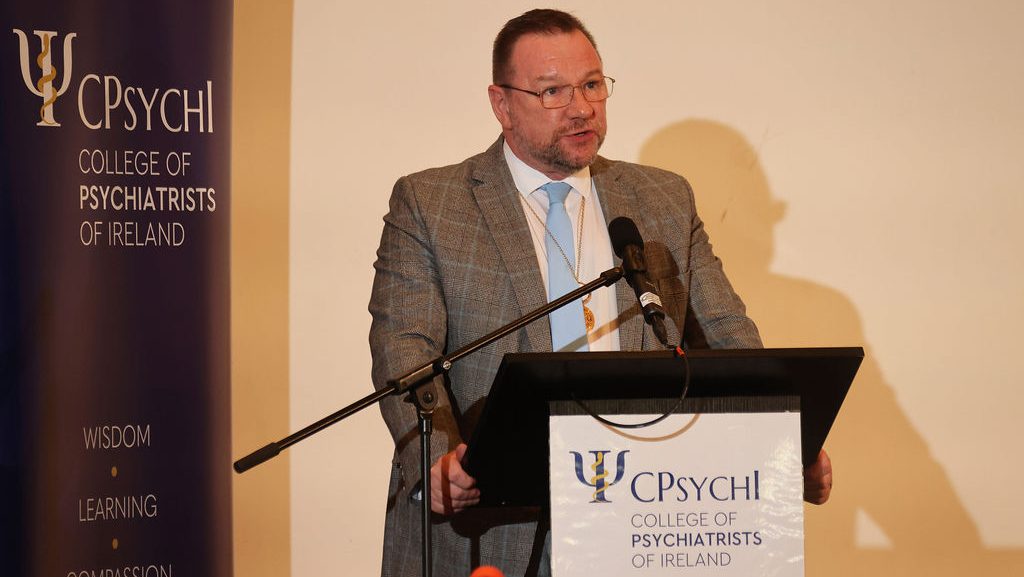
College President Dr Lorcan Martin opened the Winter Conference 2026 with an address to attendees outlining the state of psychiatry in Ireland and updates on the continued work of the College. Read it in full below.
View the conference photo gallery here.
Dia dhaoibh go léir agus fáilte chuig comhdháil an Choláiste Sicíatraí na hÉireann anseo in Óstán Lawlor’s i Nás na Ríogh. Echoing Miriam’s earlier comments, a very warm welcome to Winter Conference 2026 here in Naas. Nás means a place of assembly, so it is appropriate that we gather here today. Nás na Ríogh means assembly of the kings. Among us, we have many leaders and, perhaps, even a few kings and queens. As ever, we can look forward to a varied and dynamic selection of presentations and workshops over today and tomorrow. I would like to thank our Conference Academic Coordinator and College Vice-President, Professor Karen O’Connor, and the conference planning committee for putting together such a stimulating programme, with speakers local and international and representing many different aspects of psychiatry. Colm and Joanne have already started the day with two excellent and highly relevant presentations and I assure you there is much more to come.
It would be nice to stand up here at a conference and say that things had dramatically improved – and I would hope that it may yet happen. Today, sadly, is not that day. Across the country, mental health services remain decimated by the blunt and brutal instruments of Pay & Numbers and whole time equivalent ceilings. Considering that decimated originally meant the loss of one-tenth of your Roman legion, many services are much more than decimated, some at 50% strength. We realise that there is not a bottomless pit of money but, as has been said many times before, the mental health budget remains resolutely around half of what it should be. That said, when we hear of new spending announced by Minister Butler, as passionate and committed a Minister as we have ever had, there is no guarantee that it becomes people on the ground. The front line must be prioritised because that is where care is delivered. It is not acceptable that posts are left vacant for years on end or that it can take twelve to eighteen months to replace a vital team member. If money must be saved, let us look towards inefficiency and if posts are to be filled let us streamline the process so that it happens promptly. It is no comfort to a patient with crippling OCD or life-threatening Eating Disorder that the psychologist might be replaced in a year’s time or to those on an ever-lengthening waiting list that money is being saved by a locum consultant not being found.
We are not even safe in our jobs. Less than two weeks ago, a respected colleague was seriously assaulted and came close to being killed. I, myself, have been subjected to death threats in the past months. We are not alone in this. Across the country, psychiatrists and other professionals have been attacked, threatened or subjected to significant verbal abuse in person or on social media. We have a right to come to work and feel secure and it is incumbent upon employers to provide environments that minimise risk. They also have an obligation to take action when we are assaulted, threatened or have our good name dragged across some vile social media posts. It is not enough to be told “there’s not much we can do” or that it is up to us to take action as private individuals. If we cannot feel safe, is it any wonder people burn out and retention is a problem.
The music you heard as I came on stage was the main theme from ‘Superman’. While I am, indeed, indulging my love of John Williams, the main reason for it is to remind us that we are often expected to be Superman or Wonder Woman or some variation thereon. I asked a recently-qualified consultant how they were getting along and the answer was, “oh, my God! Everyone comes to you with everything, I need a much bigger diary”. We know that, as clinical team leaders, we need many strings to our bows but we are not ‘Super’, we are neither immortal nor invulnerable and we must take care of ourselves and support our colleagues. Do not let the very jobs we love become our Kryptonite!
So, the Mental Health Act 2026 has been signed into law, though it is far from done and dusted. The College was with it every step of the way, contributing and advising. We were invited into both the Dáil and Seanad chambers and our contributions acknowledged publicly by Minister Butler. Following the passage of the Final Stage, we were invited to the Dáil bar where, apart from the social aspect, we could continue to engage with stakeholders in a less formal way. While no piece of legislation will please everyone, it is significantly more workable than it could have been and we must now work with relevant agencies to make sure that its implementation is fair and reasonable.
Aside from activities related to the mental health legislation, College members have continued to engage with Government. Professor Bobby Smyth and Dr Emma Fletcher met with Minister Murnane O’Connor to discuss the National Drugs Strategy and, for the first time, a College delegation was invited to appear before the Oireachtas Health Committee and I would like to thank Professors Karen O’Connor and Siobhan MacHale for bringing their knowledge and experience to the session. This occasion was also noteworthy for the appearance of the Chair of the Trainee Committee, Dr Henry Roberts, who eloquently and ably brought the trainee perspective to Leinster House including a description of a real, on the ground, typical day and night for a trainee on call to ED and the rest of the service. This highlights the importance of the trainee voice and should encourage others to become involved in the College at all levels.
The College has continued to engage and develop relationships with other stakeholders such as the Psychological Society of Ireland, the Irish Association of Counselling & Psychotherapy, the Association of Occupational Therapists of Ireland, the Irish Association of Speech and Language Therapists and the Irish Association of Social Workers. This is with the aim of fostering cooperation and understanding, developing initiatives but also making sure that new ways of doing things do not disadvantage our patients or provide them with suboptimal care. There are those who have accused the College of being negative and critical. To them I say that we will continue to advocate for our patients and carers. We have welcomed, and will continue to welcome, many quality developments but we will not sit idly by and watch those most vulnerable in society be short-changed, whether it be by flawed legislation, ill-conceived models of care or unworkable pathway protocols. The old Irish expression ‘ní neart go cur le chéile’ is as relevant as ever. It means there is no strength without unity – unity as a College and unity with our sister organisations. We must continue to be leaders because often we represent those whose voices may not be heard. I am minded of a quote by, of all people, the late Dolly Parton – “If your actions create a legacy that inspires others to dream more, learn more, do more and become more, then you are an excellent leader”. That is quite some challenge for us!
So what else has been happening? In October, we co-hosted two highly successful Traveller mental health awareness events, the third time in Kerry and the first in Offaly. College members, including Consultants, Higher Specialists Trainees and REFOCUS members presented on a range of topics including addiction, suicide, men’s mental health, recovery and child and youth mental health. We also heard from members of the Traveller Community about their perspectives on these matters and others. The College’s Traveller Mental Health Position Paper provided the basis for the business plan which enabled our own team in Athlone to host an awareness and cultural session for local health care professionals. Coincidentally, these College initiatives align with Minister Butler’s own policies for improving Traveller mental health and she very kindly opened each with a video address. We have also been represented at a number of mental health awareness sessions nationwide in a variety of settings from third level education to the Irish Farmers’ Association.
Since the last conference, the College has had over 80 appearances in print, broadcast and online media, covering topics such as eating disorder, AI therapy, Traveller mental health, ADHD, Autism and Perinatal Mental Health. Our Irish Journal of Psychological Medicine, now under the leadership of Professor Anne Doherty, continues to strengthen its national and international profile publishing diverse, high-quality research, advancing its academic standing and reaffirming its commitment to influencing psychiatric practice, mental health services and policy through scientific excellence and editorial innovation and it has now attained an Impact factor of 2.5. The IJPM was proud to publish two themed issues focussing on Mental Health & Recovery and Assisted Decision Making & Mental Health Law. It has also released three new podcasts, bringing the total to ten, which you can listen to on Spotify or whatever platform tickles your auditory fancy. The Journal was also quoted in last Sunday’s Independent newspaper though, in fact, has been a constant presence in media over the last number of years related to several important topics. I would like to thank Anne and the Journal’s editorial team for their hard work. I would also like to say a massive thank you to Andrea, Harry and Ian in the EAP Department whose work never stops with inward and outward communication, liaising with stakeholders of all kinds, organising events and providing support when any of us appear in the media or put pen to paper.
In other parts of the College, work continues apace. Professor Aoibhinn Lynch, Kellie Myers and the team in Post-Graduate Training keep the show on the road in what is the most robust and supportive training scheme in the country. The amount of work is often unseen and, in addition to running the scheme and twice-yearly exams, there is frequent and lengthy negotiation with many other stakeholders and the additional work of developing a new curriculum which will reflect more comprehensive and real-world assessment methods. Applicants for Basic Specialist Training outnumber the available places by a factor of three, proving that Psychiatry is attractive as a speciality – and we could train more if we were given funding for more training places – but also providing even more work for the team. All this is done in a background of shifting sands and uncertainty regarding the new HSE structures and fragmenting budgets. I am surprised Aoibhinn and Kellie have either hair or nails left!
While the Professional Competence Department may only pop into many heads around late April as our PCS year draws to a close, the work of Ciaran, Lorna and Olga is most definitely year-round. The Department continues to provide us with high-quality and varied CPD events along with assessing others for suitability for CPD, liaising with the Medical Council, supporting members… that list goes on. Having worked in PCS for a number of years, I can assure you that it is a hive of activity up under the rafters of Herbert Street.
At our Spring conference, you might remember I asked you to engage in a membership survey which would go on to inform the development of the College’s strategy for the coming years. I would like to thank everyone who contributed in such detail. Overall, respondents were satisfied with what the College does and is today while also coming up with some useful and innovative suggestions. Other stakeholders, both internal and external were also surveyed and the strategy is well on its way to completion. This important document will help us guide the College into what are sure to be challenging times. We must acknowledge Prof. Karen O’Connor for keeping her foot on the pedal of this process and also the strategy working group who have repeatedly given of their time.
Our College continues to grow in numbers and diversity. We now have members from 63 countries, representing just under a third of the world’s nations. Over the last number of years we have embraced that diversity, recognising it as a strength, not a source of division. In August, we celebrated it a fun and joyous way when we hosted a multicultural evening in our building. 5 Herbert Street came alive with colour, vibrated to the sounds of music and dance and delighted in the fragrances of foods from across the globe. National costume was full display as we enjoyed presentations on history and culture of member nations and heard songs and poetry in many languages. It wasn’t about CPD, service provision or advocacy. It was a time for our College to just be, well, collegial, and I would like to thank everyone who helped make it such a special and memorable occasion.
Over the last few minutes, I have mentioned many people by name who, quite rightly, deserve our gratitude for their tireless efforts on behalf of us all, often on top of their regular work commitments. However, there are many more members who have contributed to ARPs, exams, working groups, SIGs, Faculties, etc. The list goes on and we are so grateful. That said, there is always room for more, so never think you can’t contribute, whatever your interest or available time. As you can see, I am not above shameless canvassing.
Why do we attend conferences? Would it not be easier to watch a webinar and save time? I had this discussion with a friend and colleague recently. We agreed it was the networking, the catching up, the chats over coffee. But then she said something I hadn’t considered. Attending conferences can inspire us and remind us why we became psychiatrists, removed from the stresses of our day-to-day jobs, and able to rediscover the art, the science and the nobility of our profession. They are also opportunities to embarrass oneself on a dancefloor and I am a recidivist in this. But events like this don’t just pop up out a box, delivered by an on line retailer. They take months of preparation and dedicated work. I mentioned Karen and the Committee earlier but we must express our thanks in great quantity to Miriam, Jennie and the team in the College who make sure we have a roof over our heads, a cup of coffee in our hands and the technology to see and hear the excellent presentations.
I hope you will enjoy these two days of academic excellence. I hope also that you will meeting friends, chatting over a coffee or tripping the light fantastic. Most of all, I hope we can rediscover the wonder of being a psychiatrist. Have a fantastic conference and remember #itsaboutpeople