The College will achieve this by developing policy statements and positions papers on specific issues; by listening to and communicating with members, people who use mental health services, their carers and groups that represent them; by organising conferences, training courses and workshops; by publishing reports and good practice guides; by maintaining a website and liaising with members and service users and appropriate Government Departments and other bodies (national & international) with a view to achieving its aims.
The College will communicate with its members and stakeholders effectively and efficiently so that greater awareness of psychiatric issues and the challenges facing psychiatry is created. The College will also both proactively and reactively engage on psychiatric issues so as to improve understanding and awareness in the widest possible audience.
College Media Interaction
The College has a Communication Policy document which can be found on the website under the External Affairs & Policy section and in which the procedure for dealing with media can be found. A guide for assessing media involvement by category document is also available and should be adhered to.
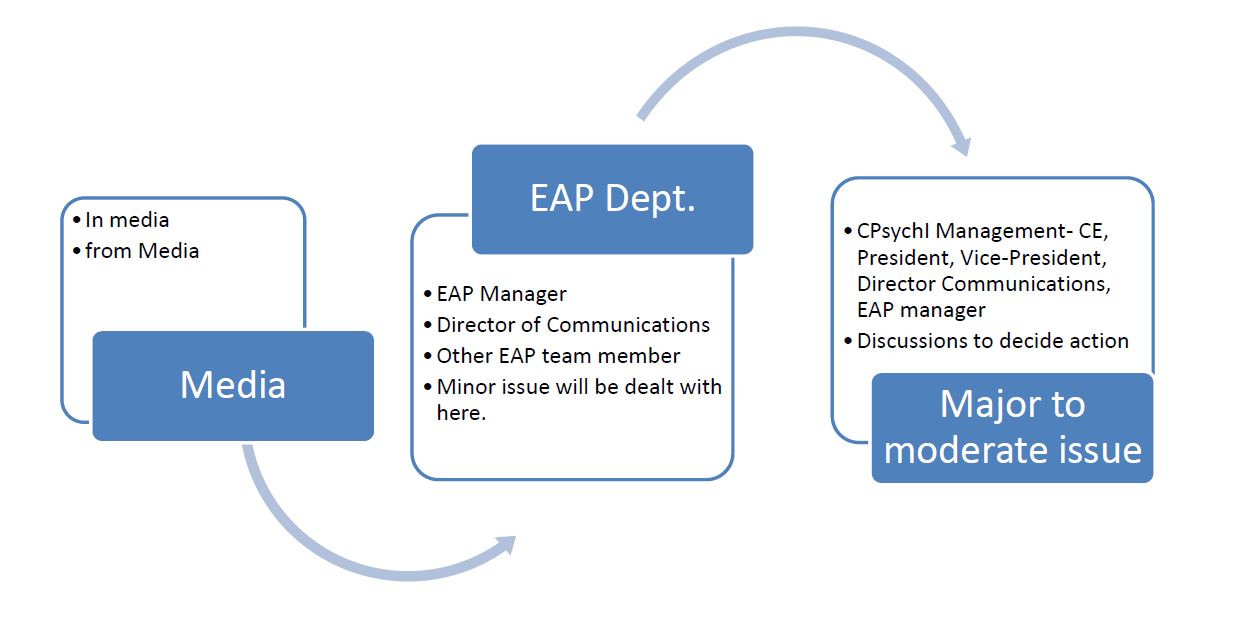
Below is an easy reference to the process of dealing with media activity and queries and when they occur.
All queries by the media or about issues in the media must be directed to the EAP Department.
- the query must go to the Manager first by phone and /or email.
- if the Manager is unavailable, then the query should be directed to the Communication’s Assistant and then to the Digital Communications Administrator.
- the Director of Communications & Public Education must be informed by the EAP department at some point. The timing of such contact will depend on the nature of the issue involved (See below)
Major issue
The Director of Communications, the President, the Vice-President, the Chief Executive and the Manager of EAP must be contacted by phone by the EAP Department and informed if:
- an issue arises in the media that is of College member’s concern, of national significance, of grave concern, of public safety and /or affects service users/patients, carers and the profession of psychiatry including trainees.
- the reputation of the College is at stake or incorrectly depicted in media
- there is a risk of Litigation involving College interest
- urgent correction is required
The Director of Communications and the EAP Manager must be informed first of any major issue. Any response to a Major Issue must come from the Director of Communication and the Manager of EAP who will consult with the President, the Chief Executive and relevant officers of the College depending on the issue in question.
Medium issue
Contact and inform the Director of Communications, the Manager of EAP and the Chief Executive before responding. Refer to category document.
Minor issue
The EAP department will decide if the query should be followed up on or not and will inform the Director re the query and action/answer taken if any. Usually an email to inform the Manager and Director is sufficient. If the minor query involves asking a member psychiatrist to be involved the Manager and/or Manager will advise but both must be informed of the decision.