

Eating Disorders Awareness Week is from 23 February to March 1st. The Eating Disorder Special Interest Group has produced a series of articles that are being released throughout the week. This piece is by Louise Quinn, a Senior Art Therapist within an inpatient mental health service.
Eating disorders are complex mental health conditions that can thrive in secrecy and isolation. They are characterised by negative cognitions and emotional difficulties, yet eating disorders are also embodied, in that they manifest physically though sensations, urges, rituals and perceptions of the body. While many people in recovery are highly articulate it can be challenging to find words to accurately and openly communicate these complex embodied experiences. Art and creativity can offer a powerful language to bridge between inner experience and outward expression in eating disorder recovery.
Using art in recovery is a core process of Art Therapy as a therapeutic modality. It can offer a clinically valuable pathway for expression, regulation and it can enhance insight and learning. Art therapy is well documented in eating disorder treatment integrated in a multidisciplinary framework and the evidence base is developing.
What is Art therapy?
Art therapy is an established form of psychotherapy where the art making process is central to the therapeutic intervention and it is delivered by a trained art therapist. Through the imagery which can often use symbol and metaphor difficult material can be expressed in an indirect way and it can support individuals to build their readiness to share their story. Art making is not only used to express and communicate thoughts and emotions it is also used to engage individuals on a sensory level to enable emotional processing and emotional regulation through experiential processes.
Mindfulness and self-regulation
Making art or creating can naturally bring you into the present moment and can offer periods of absorption. Creative processes can support nervous system regulation through rhythmic movement, sensory engagement and creative decision making. Sensory aspects of art materials can modulate arousal and increase capacity to integrate therapeutic work. There is value in art therapy as a ‘bottom up’ approach as opposed to solely a cognitive or ‘top down’ approach in relation to emotional regulation.
Shifting the relationship with control and perfectionism
Eating disorders drive cognitive rigidity and control however engaging with new and different materials in art therapy can promote flexibility and adaptability. It is important to recognise that art therapy doesn’t focus on being skilled at art. In fact the art-making process promotes opportunities for play, experimentation and reflection, moving away from judgement and competitiveness. For some, the ambiguity and unpredictable nature of art making can be daunting. By offering some structure in the art therapy sessions, the therapist can support individuals to take safe risks with unfamiliar art materials. This can develop more flexible attitudes, challenge perfectionistic ideals and develop an openness to the art-making process. While the focus in art therapy is not about achievement the arts can provide a sense of mastery and restore a sense of empowerment and agency in creating personal artworks.
Creativity can support connectedness
In many clinical settings art therapy can be delivered in groups. Art therapy groups are unique in that they create a shared creative space where group members can share their experiences through their art with others in the group in a safe therapeutic setting. Artworks are something that can be looked at together from a distance and reflected upon. This can enable participants to feel understood and validated without having to explain their experiences directly. The group can also be an opportunity to experience each other in a different light, as they reconnect with often neglected creative parts of themselves.
Finding a voice
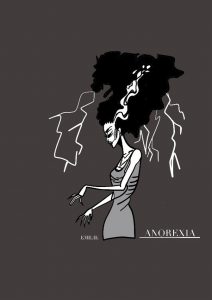
Emilie who has lived experience of anorexia has used her creative process to communicate the depth of her experience with her treating team. Emilie has used both poetry and art to support her recovery and has generously and courageously shared her work here with permission
Similar to making art, creating poetry can be an affirming act and a valuable medium to express complex ideas when normal language is found lacking. Poetry is often imbued with imagery and symbol and can work in harmony with visual art. A poem can connect us directly with its speaker and create a strong empathic connection.
In her artwork ‘Anorexia’ and her poem “When the Shadows speak”, Emilie explores her relationship with anorexia giving visual form to the eating disorder and portrays it as something external to her. A significant element of many recommended eating disorder therapies can include this process of externalising the eating disorder as separate from the person. This can position the eating disorder as an external influence and emphasises that the problem is the eating disorder and not the person living with it. This can enable the ED to be challenged and understood without judging the person.
The arts are well positioned to develop this kind of work, artistic expression can support the courage to share and bring these painful experiences out of the shadows.
With sincere thanks to Emilie for sharing her work “When the Shadows Speak”:
“When the Shadows speak”
I sit in a room full of people,
Yet anorexia sits right beside me, with zero personal space.
She’s that close to me that over time she has become the biggest part of me
She holds my hand tightly and controlling, like the best worst friend
She whispers “you belong to me”
No one notices, no one sees it, but it has slowly collapsed me
I smile, I nod, I exist,
But I do not live
Some days I carry her on my back, a heaviness, thick of control
She whispers all the things I shouldn’t of done, what I should do, I follow her demands
People ask, “how are you?”
I answer in half-truths, I fold the truth into small, polite pieces
The full truths of anorexia will never be told and the pieces will never be unfolded
I have perfected the art of pretending.
The jokes, the laughter, the conversations that flow.
It’s all just a costume we tailored to fit all expectations.
But at night, when it’s alone,
The costume peels off, leaving the raw aching truth of it all
The truth of who I really am,
How I always feel
The world sleeps, but my mind does not
Sleep is just a rewind of all the memories I wish I could forget
The ceiling becomes my only witness of the rewinds
Counting all the things I could of done better, things I should of done, blaming me
Shadows whisper in the night memories unseen
They crawl like spiders in my mind,
A trap I can’t leave behind
When the shadows speak.
Emilie has accessed eating disorder treatment through the HSE. Louise Quinn is a Senior Art Therapist within an inpatient mental health service.