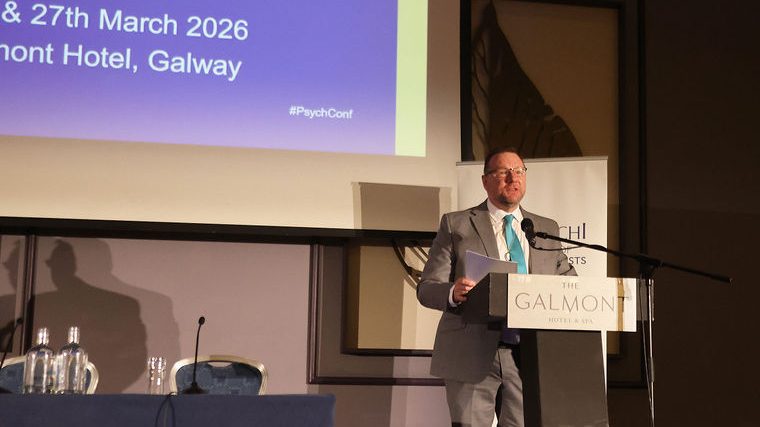
In his opening address at the Spring Conference 2026, College President Dr Lorcan Martin discussed the ongoing work by the College on the Mental Health Bill 2024, the newly-released joint position on AI therapy and more.
Read the full text of the speech below, and view the full conference programme here.
View the conference photo gallery here (members only).
Dia dhaoibh go léir agus fáilte chuig comhdháil an Choláiste Sicíatraí na hÉireann. Good morning everyone and, to echo Miriam’s earlier comments, welcome to Spring Conference 2026 here in the lovely City of the Tribes. As ever, we can look forward to a varied and dynamic selection of presentations and workshops over the coming days. I would like to thank our Conference Academic Coordinator and College Vice-President, Dr. Karen O’Connor, and the committee for putting together such a stimulating programme, with speakers local and international and representing many different aspects of psychiatry. Eddie and May have already set the tone with their excellent, thought-provoking and diverse presentations and I assure you there is much more to come.
Due to the nature of our joint conference with RCPsychNI last November, you were spared the suffering of me droning on. You’re not so lucky this time but I promise I won’t go on twice as long to make up for last time – or will I? Since it has been so long, perhaps we might need a ‘previously on…’ prologue to catch up. Unfortunately, however, the landscape is all too recognisable from when I stood in front of you a year ago. Budgets, Bills (legislative and otherwise), reports and restructuring continue to leave us positively bedevilled and psychiatry remains the poor relation of the health services.
Without a doubt, the biggest challenge facing us is new mental health legislation. This time last year, we were looking at a Bill beyond unworkable which would have left patients languishing and untreated. Thankfully, the situation has improved somewhat and some of the more objectionable parts have been removed or attenuated and I would like to acknowledge Minister Butler for her part in resisting many outlandish amendments which were brought forward. We would also like to commend her for reminding, on record, those in the Seanad who would say otherwise that a psychiatric hospital is a place of treatment and not a prison. That said, there are still a number of areas of concern for us. Firstly, there is the involvement of the Courts in a patient’s treatment. While we will now have 42 days in which we may treat a patient lacking capacity to consent, we do not believe that the Courts have any place in the treatment of such patients. Sufficient safeguards are already in place and the inclusion of the Courts will make the process cumbersome, resource-intensive and, furthermore, will stigmatise patients with mental illness. Secondly, we now have the inclusion of ‘pharmacological restraint’, an absurd notion in which we do not engage. Yet, its mere inclusion will, despite a narrow definition, lead to rules and codes of practice which will further attempt to prevent us treating seriously ill patients. Now, that is what I call restrictive practice! Another area of concern is the removal of the prohibition of staff from approved centres making applications for involuntary admissions. Aside from obvious ethical considerations, it is unclear how that will affect staffing but you may be assured it will not be positive. There also remains the outlandish provision whereby the Courts can override the wishes of a person with capacity to oblige them to take treatment – that will be an interesting challenge when the time comes if not removed before the Bill officially becomes the new Act. We have, of course, written to Minister Butler again regarding those four issues just mentioned. Before we leave the Mental Health Bill, I would like to acknowledge those who have contributed to the College’s responses to it and, in particular, say a massive thank you to Dr. Joanne Fegan, our Director of Communication and Public Education, who has put more hours than any of us could count into parsing and scrutinising dense legal text, so that we could produce the most effective responses possible.
We live in a world where technology evolves so rapidly that humans can barely keep up. Despite the fact that many of us lack adequate ICT systems and the dream of a national electronic record remains just that, we see artificial intelligence making unwelcome and dangerous inroads into the mental health arena. Let me be clear – we do not oppose appropriately developed and regulated technology, AI or otherwise. What is concerning is the use of AI bots and companions as ersatz therapists and this has already led to a number of tragic deaths, with artificial intelligence encouraging or assisting suicide. Today, the College, along with the Psychological Society of Ireland and Irish Association of Counselling and Psychotherapy called for legislation banning such AI therapy. We are delighted to have worked with our sister organisations on this, having previously worked on a Memorandum of Understanding banning conversion therapy. We have also worked with the PSI and a number of other organisations opposing the entirely unfit-for purpose HSE Autism Pathway and Protocol. Of course, linking with other bodies is not all about opposition and the College and PSI took part in IACP’s conference in late 2025 and will embark on other initiatives together. In an international context, the College will shortly sign an agreement with our companion body in Oman which will bring psychiatric trainees seeking additional experience to the Irish healthcare system, at no additional cost to the taxpayer.
So what else have we been up to? The College’s presence in print and broadcast media goes from strength to strength; it is not unusual for journalists to now come to us for comment and interviews proactively on various topics and not just in reaction to an issue. This is undoubtedly due to the balanced and expert opinions shared by members in the media and the hard work of our EAP department. We have continued, and will continue, to engage with many different stakeholders in various arenas. The ‘Mind Matters’ series of videos on our website provide useful information for the public delivered by specialist psychiatrists. We have perinatal lived experience videos and lived experience videos by REFOCUS members, who continue to play an important role in the College and I recommend to you the REFOCUS plenary session tomorrow. We are currently building a repository of resources on our website to use in-service with patients. Last October saw our second successful Traveller Mental Health event in Kerry which coincided with the launch of our position paper on Traveller Mental Health and, in December, we hosted a delegation of Ukrainian psychiatrists who were exploring setting up a service for war veterans. This is just the tip of the iceberg and I could go on for much longer – you will, no doubt, be relieved that I won’t. However, I would like to express appreciation to all the members who have contributed to these and the other countless activities.
Everybody counts or nobody counts! In a world where we see ever increasing divides between the haves and have nots, the strong and the weak and those who shout loudest and those who are voiceless, we are in a unique position to advocate for those with mental illness. They are frequently marginalised, disadvantaged and unheard. Many years ago, I heard a nurse with whom I worked cynically say ‘there are no votes in psychiatry, Doctor’. Like many cliches, it was founded in truth. It speaks to many of our patients being unable to represent themselves and to families and carers unwilling to do so due to stigma. Thankfully, this is slowly changing with greater societal acceptance of mental illnesses, though not always the more severe. We are fortunate that our current Minister takes a keen interest in mental health services. The College’s own REFOCUS group works proactively in areas such as training and advising on policy. However, we have a long way to go before our patients have true parity with those in other disciplines. When I came up here today, you heard the opening of ‘When The Going Gets Tough’. Unfortunately, sometimes we need to get tough. We hear of billions going into health services while our portion remains around under a paltry 6%, we see multidisciplinary teams eviscerated by a bizarre policy of cutting empty posts and we struggle to find a meaningful place in yet another arbitrary restructuring of the health service. The process of being asked to do more with less continues unabated and it often falls to us to shout when our patients cannot. While the College continues to press home these messages, I would urge everyone to use every opportunity to advocate on behalf of our services that we may better treat our patients, primarily, but also provide a better working environment so that we can reduce the risk of burnout and loss of much needed expertise.
I want to talk to you about a survey. I know you probably have survey fatigue and I can see many pairs of eyes rolling at the mere mention of yet another one. However, this one is especially important and was sent out to members earlier this week. Led by our Vice-President, Dr Karen O’Connor, the College is developing its strategy for the next five years. This survey is your opportunity, as members, to help shape that strategy in a wide number of key areas. It may be a little longer than some surveys, but it should still take no more than eight minutes, though feel free to take as long as you like to provide additional information. I would encourage as many people as possible to complete this survey as openly and honestly as possible, regardless of career stage or membership category. It is completely anonymous and can be done via the link that was emailed to all members. However, given the miracles of modern technology, you can also simply scan the QR code on your conference programme. I would like to thank the strategy working group for their contributions, so far, and an especially big thank you to Karen and also to Andrea in EAP for putting this survey together and, trust me, it is a much bigger job than it looks.
The beautiful thing about learning is that it can’t be taken away from you. A secretary with whom I worked used to say, “you learn something new every day and still go to bed stupid”. I wouldn’t dare to suggest that anyone in this room is stupid but I think we all recognise the need for and pleasure in ongoing learning and development of expertise. To this end, I would like to acknowledge the extraordinary work carried out by Aoibhinn, Kellie and the Postgraduate Training Department in making sure the psychiatrists of the future meet the highest standards in a training scheme that is second to none. Their advocacy and consistent work with NDTP to secure training posts and to ensure training standards are met in services is admirable, appreciated and, I am sure, exhausting. We should also acknowledge the Vice-Deans, Tutors, Mentors and Educational Supervisors without whom it simply could not work. For those of us for whom training is but a memory, we are lucky to have Ciaran, Lorna and the Professional Competence Department who provide us with a constant and varied selection of high-quality CPD events and support us in so many other ways in maintaining our professional competence – and, briefly robbing Ciaran’s hat – make sure your diary is up to date. The PCS year ends soon!
If I may, I would like to take a few moments for a personal note. For the last three years, I have been afforded the privilege of serving as President of this College. It has been an extraordinary experience and has given me the chance to work with some amazing and dedicated people. Members continue to give of their time despite enormous clinical commitments. But I would also like to acknowledge the team of the College who are often little more than names on emails to many but who keep this massive show on the road. They are not psychiatrists but they fight for and support our profession as much as any psychiatrist I have met. I would like to thank deeply all those who have supported me in my role. The bad news is that you are going to be stuck with me for another term but I promise to represent and serve you to the best of my ability in the coming years, God willing.
The full-scale production you see today and tomorrow took real, not artificial, intelligence. It also took an enormous amount of sheer hard work. I already mentioned Karen and the committee but I would like to say a huge thank you to Miriam, Jennie and all the staff working away in the background, making sure we are fed, watered, educated and entertained. They get here long before we do to ensure everything goes according to plan and we are very grateful.
Ahead of you are two days of academic excellence, and I hope you will find plenty to interest and stimulate you. However, conferences are about more than just learning. They are an opportunity to meet or re-connect with colleagues, old and new. I hope I get to meet as many of you as possible over the coming days and, to those who are coming to this evening’s dinner, make sure you bring your dancing shoes! Have a wonderful conference and remember #itsaboutpeople